
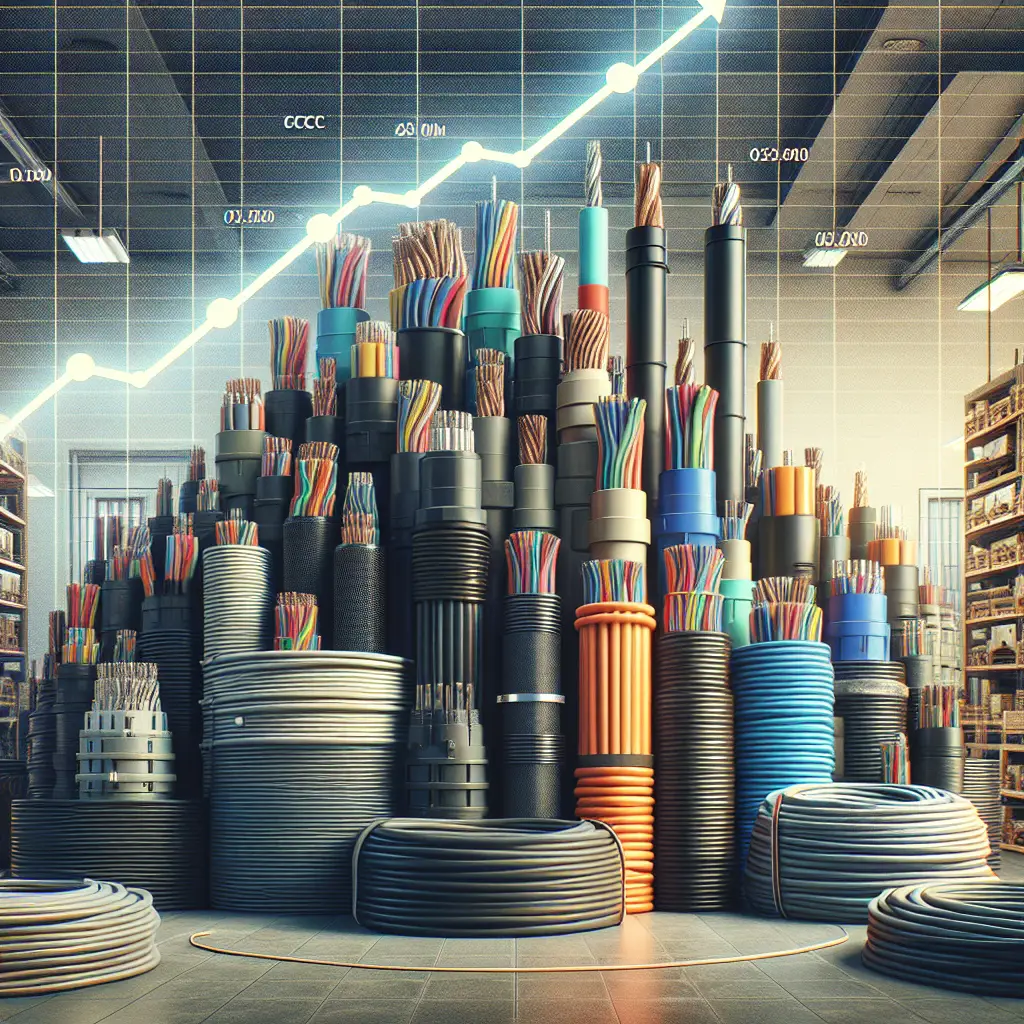
In a recent publication by IMARC Group, it was revealed that the size of the power cable market in the Gulf Cooperation Council (GCC) region reached a significant USD 3.6 Billion in 2024. The market is anticipated to expand to USD 6.2 Billion by 2033, demonstrating a compound annual growth rate (CAGR) of 6.3% during the period of 2025-2033.
Artificial Intelligence (AI) is playing a pivotal role in reshaping the future of the GCC power cable market. AI algorithms are being utilized for predictive maintenance, analyzing sensor data from smart cables to detect early signs of wear, vibrations, and thermal anomalies. This proactive approach has resulted in a reduction of downtime by up to 20% in Saudi Arabia’s solar farms and UAE data centers.
Machine learning systems are being employed for real-time load optimization. These systems monitor power consumption patterns across GCC grids, automatically balancing loads and reducing cable stress during peak hours, thereby optimizing energy distribution efficiency.
Quality control has also seen significant enhancement through the use of AI. Computer vision and AI-powered inspection systems are being used to detect microscopic defects in cable manufacturing, ensuring superior insulation and conductor quality before deployment in critical infrastructure projects.
AI is also being used to create digital twins of entire cable networks. These virtual replicas simulate performance under different conditions, enabling engineers to test upgrades virtually before physical implementation across expanding renewable energy grids.
AI systems are enabling cables to communicate within intelligent grids, facilitating seamless integration of solar and wind power while managing intermittent energy flows through automated switching and routing decisions.
Saudi Arabia’s Vision 2030 and the UAE’s Vision 2071 are revolutionizing the GCC power cable industry. These visions involve massive infrastructure investments that are fundamentally transforming power cable demand. Saudi Arabia aims to achieve 50% renewable energy in its electricity mix, requiring 130 gigawatts of capacity with 58.7 GW from solar and 40 GW from wind.
The UAE’s Digital Government Strategy and Abu Dhabi’s target of 50% EV penetration by 2040 with 70,000 charging stations planned are creating sustained demand for high-voltage transmission cables. Kuwait’s 17GW renewable energy and 25GW green hydrogen masterplan signed in July 2024 reinforces long-term requirements.
Qatar’s Ashghal launched a 2 billion QAR underground cable project in March 2025 featuring AI-powered monitoring. These initiatives, combined with smart city developments across Riyadh, Dubai, and Doha, position power cables as foundational infrastructure for the region’s sustainable transformation.
Mega infrastructure projects and renewable energy transitions are reshaping GCC power cable demand at an unprecedented scale. Saudi Arabia’s NEOM, UAE’s Expo City, and Qatar’s Lusai are just a few examples of the projects driving this transformation.