

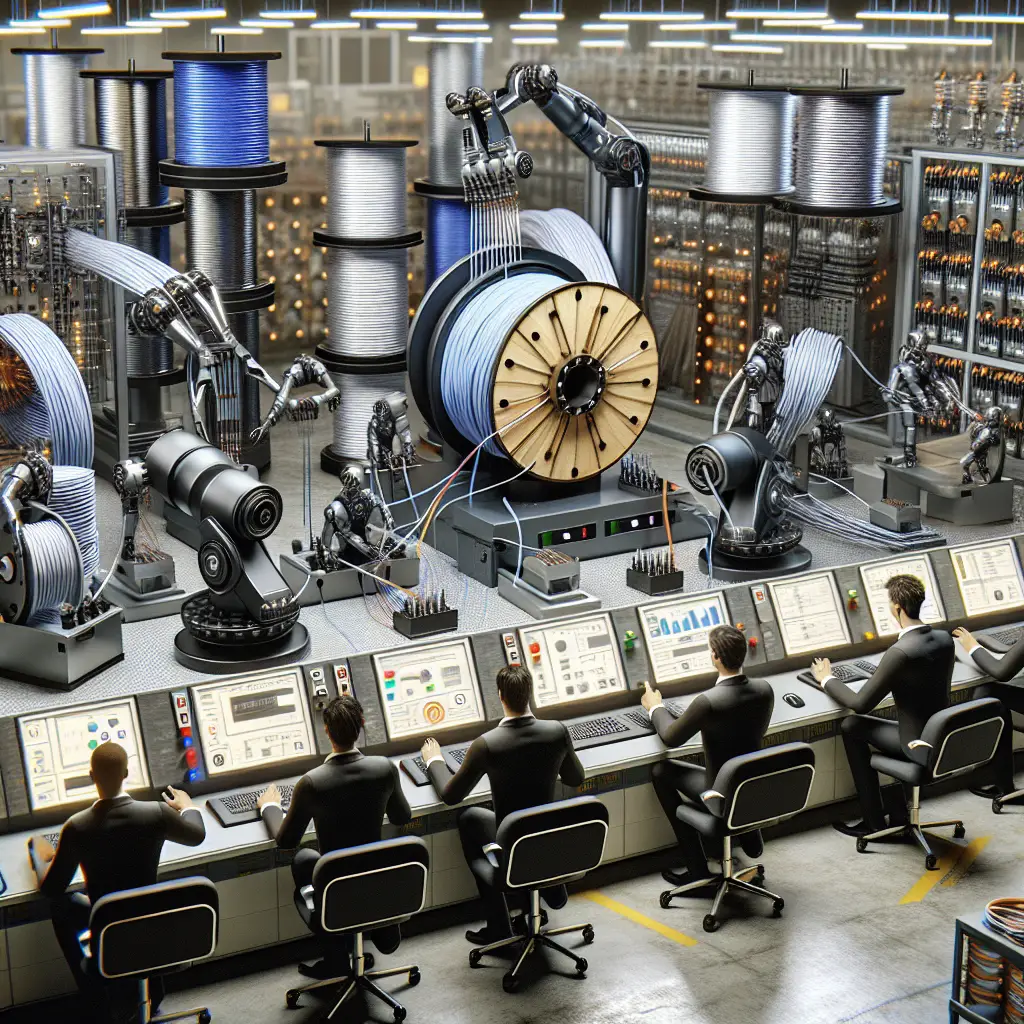
Q5D Technologies, a pioneering manufacturing firm, is revolutionising the traditionally manual process of wiring harness production. The company’s specialisation lies in the automation of this process across various sectors, including automotive, aerospace, consumer electronics, and white goods. Established in 2018 and headquartered in Portishead, Bristol, Q5D Technologies has successfully developed robotic systems that automate the routing, laying, terminating, and integrating of wiring into both flat and intricate 3D surfaces.
This remarkable achievement is the result of a successful fusion of additive manufacturing, printed electronics, laser micromachining, and 5-axis robotics. The outcome is a more efficient production of wiring harnesses, significantly reducing labour and manufacturing requirements.
Q5D Technologies offers more than just hardware. The company also provides design and production software, facilitating the complete digitalisation of wiring harness manufacturing workflows. This includes support for digital-twin-ready processes.
Chris Elsworthy, the founder and CTO of Q5D, stated, “Our goal is to completely transform the manufacturing of electrical wiring systems and embedded electronics. We aim to introduce automation, precision, and greater design freedom to a process that has traditionally been heavily reliant on manual assembly.”
At the core of the system are multi-axis robotic manufacturing platforms. These have been designed to automate the addition of conductors, terminations, and electronic features onto both flat and complex 3D surfaces.
Elsworthy further explained, “Our 5-axis motion systems allow toolpaths to be executed over highly curved or irregular geometries. Our CY10-L machine can process components as large as one meter by half a meter, offering designers and manufacturers unprecedented flexibility in terms of component layout and form factor.”
The CY10-L is a significant technological differentiator for Q5D Technologies. It extends the principles of printed electronics into fully three-dimensional space.
“The CY10-L system merges a 100-watt fibre laser with ultrasonic spray deposition to form conductive traces, metallized pathways, and functional surfaces directly onto structural parts. This method enables fine resolutions down to 100 microns and allows electronics to be integrated onto surfaces where traditional printed circuit techniques are inadequate, such as large curved housings or complex mouldings,” Elsworthy elaborated.
While conventional additive electronics methods are typically limited to planar substrates and require specialised materials, Q5D’s laser-assisted process is versatile. It works across a wide variety of geometries and supports the growing demand for three-dimensional, additively manufactured electronics.
Q5D’s robotic systems can route, protect, and terminate wires automatically. These systems can integrate wiring into the surfaces of 3D components or produce freestanding harnesses with minimal fixturing.
Elsworthy concluded, “This type of automation not only increases precision and repeatability but also reduces the need for manual labour, leading to significant cost savings.